How Long to Run Sprinkler for 1 Inch of Water? Save Money!
Last summer, my neighbor’s lawn turned brown and crispy. Mine stayed green and healthy. What was the difference? He was guessing how long to water. I was measuring. After killing three lawns in my first five years as a homeowner, I finally figured out the right way to water grass.
Here’s the short answer: You need to run your sprinkler for 20 minutes to 2 hours to get 1 inch of water. The exact time depends on what kind of sprinkler you use, your water pressure, and a few other things. That’s a big range, right? Don’t worry. I’ll show you exactly how to find the right time for your yard.
In this guide, you’ll learn how to measure your sprinkler output. We’ll talk about why water pressure matters more than the brand of sprinkler you buy. I’ll also share the mistakes I made so you can avoid them.
What Does ” 1 Inch of Water ” Mean?
One inch of water soaks about 6 to 8 inches into your soil. That’s where grass roots drink up moisture. This amount is similar to what your lawn gets from a good rainstorm.
Why 1 inch? Scientists who study grass have tested this for decades. They found that light, daily watering makes roots stay near the surface. Deep watering once or twice a week makes roots grow down. Deep roots help your lawn survive hot, dry weather.
I learned this lesson the hard way in 2019. I was watering my lawn for just 10 minutes every day. The grass looked fine at first. But when I went on vacation for two weeks, everything died. The roots were only 2 inches deep. They couldn’t reach water deeper in the soil.
Here’s the math: 1 inch of water on 1 square foot of lawn equals about 0.6 gallons. For a 5,000 square foot lawn, that’s over 3,000 gallons per watering. Getting the timing right saves water and money.
Your Soil Type Matters
Different soils absorb water at different speeds. Sandy soil soaks up water fast but doesn’t hold it long. Clay soil absorbs water slowly but holds it for days. Loamy soil is in the middle and works best.
Here’s what I’ve found:
| Soil Type | How Fast It Absorbs | How Long It Holds Water |
| Sandy | Very fast | 2-3 days |
| Clay | Very slow | 7+ days |
| Loam | Medium | 4-5 days |
When I moved from sandy soil in Florida to clay soil in Tennessee, I had to relearn everything. My usual 20-minute watering created puddles on clay. The water just ran off into the street.
How Long Does Each Sprinkler Type Take?
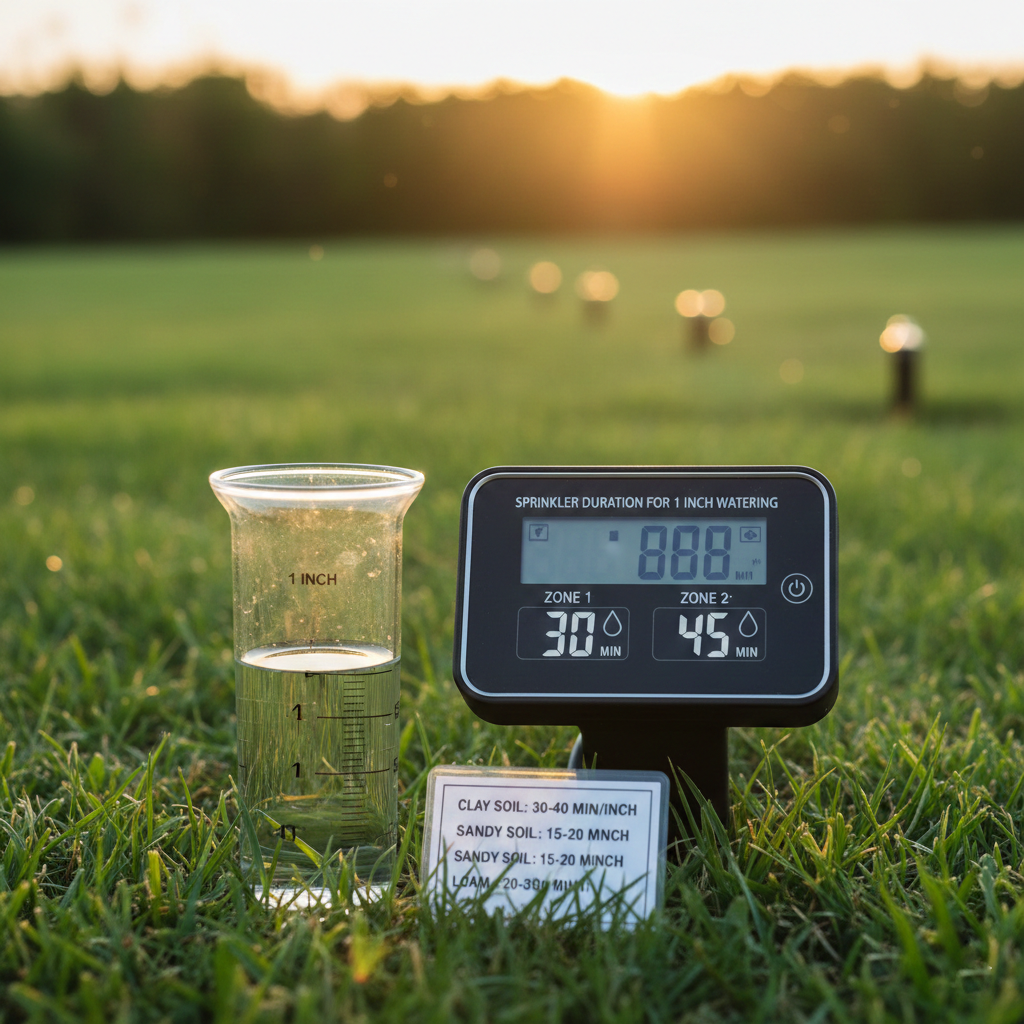
The kind of sprinkler you use is the biggest factor in how long to water. Different sprinklers spray water at different speeds.
Oscillating Sprinklers: 45-90 Minutes
These are the rectangular-spray sprinklers you see everywhere. They’re popular but slow. Most put out about half an inch to 1 inch of water per hour.
I tested a Melnor model that took about 62 minutes to deliver 1 inch. A cheaper Gilmour model took 85 minutes. Wind makes these even slower because it blows water away.
Rotary Sprinklers: 35-60 Minutes
Sprinklers with spinning arms work faster than oscillating ones. The spinning motion pushes water into the ground better and wastes less to evaporation.
My favorite rotary sprinkler delivers 1 inch in about 42 minutes. It costs around $35 but works great.
Impact Sprinklers: 25-45 Minutes
They still work really well. They handle high water pressure and spray big water drops that don’t blow away in the wind.
The Rain Bird model I use delivers 1 inch in about 30 minutes. The only downside? They’re loud.
In-Ground Systems: 15-30 Minutes
Built-in sprinkler systems are the fastest and most efficient. But they cost a lot to install. Professional installation runs $2,500 to $4,500 for most yards.
My in-ground system delivers 1 inch in about 22 minutes per zone. Once set up, it works the same way every time.
Drip Systems and Soaker Hoses: 60-120 Minutes
These deliver water slowly right to the roots. They take 1 to 2 hours but waste very little water to evaporation.
The Tuna Can Test: Measure Your Sprinkler
Stop guessing. Start measuring.The tuna can test tells you exactly how long YOUR sprinkler takes to deliver 1 inch of water.
How to Do It
1. Get 5 or 6 empty containers.** Tuna cans work great because they’re about 1 inch tall. You can also use cat food cans or small cups.
2. Spread them around your yard.** Put some close to the sprinkler and some far away.
3. Run your sprinkler for 15 minutes.** Use a timer.
4. Measure the water in each can.** Use a ruler.
5. Find the average.** Add up all the measurements and divide by the number of cans.
6. Calculate your time.** If you got 0.25 inches in 15 minutes, you need 60 minutes for 1 inch. The math: 15 ÷ 0.25 = 60.
When I first did this test, I was shocked. My sprinkler was only putting out 0.35 inches in 30 minutes. I thought I was watering enough, but my lawn was actually drying out.
Why Location Matters
Most sprinklers don’t spray evenly. Areas close to the sprinkler often get 2 to 3 times more water than edges. This is why you might have brown patches even when you water regularly.
How Water Pressure Changes Your Timing
A 10 PSI change in water pressure can change your sprinkler output by 15 to 25%. Most people never check their water pressure. That’s a mistake.
Home water pressure usually runs between 40 and 80 PSI.
Signs of Low Pressure (Below 40 PSI)
– Water doesn’t spray very far
– Weak, dribbling spray
– Sprinkler barely moves or rotates
Signs of High Pressure (Above 60 PSI)
– Fine mist instead of water drops
– Water blows away in the wind
– Puddles form at spray heads
You can buy a pressure gauge at any hardware store for $10 to $15. Just screw it onto an outdoor faucet and turn on the water.
Seasonal Changes: Summer vs. Winter Watering
Your lawn needs different amounts of water throughout the year. Using the same schedule all year wastes water and can hurt your grass.
Spring (March-May)
Grass wakes up hungry for water. I water about 0.75 to 1 inch per week, split into two sessions. Tuesday and Saturday mornings work well for me.
Summer (June-August)
Hot weather means grass loses water fast. You might need 1.5 to 2 inches per week during heat waves.
I water twice a week in summer, 1 inch each time. Always water early morning before 9 AM. This gives you the least evaporation.
Fall (September-November)
Grass slows down as temperatures drop. Cut back to 0.75 inches per week by October. Once nights get into the 40s, water only every 10 to 14 days.
Winter (December-February)
Sleeping lawns still need some moisture. I water once a month during dry spells, about 0.5 inches just to keep roots from drying out.
The Cycle and Soak Method for Tough Soil
If water runs off before soaking in, break your watering into cycles. This works great for clay soil and slopes.
Instead of running my sprinkler for 45 minutes straight, I break it into three 15-minute sessions. I wait 30 minutes between each one. The total water is the same, but it all soaks in instead of running off.
Example schedule:
– 6:00 AM: Water for 15 minutes
– 6:30 AM: Water for 15 minutes
– 7:00 AM: Water for 15 minutes
For steep slopes, use even shorter cycles. My neighbor with a steep yard does six 5-minute sessions with 20-minute breaks.
Smart Controllers: Are They Worth It?
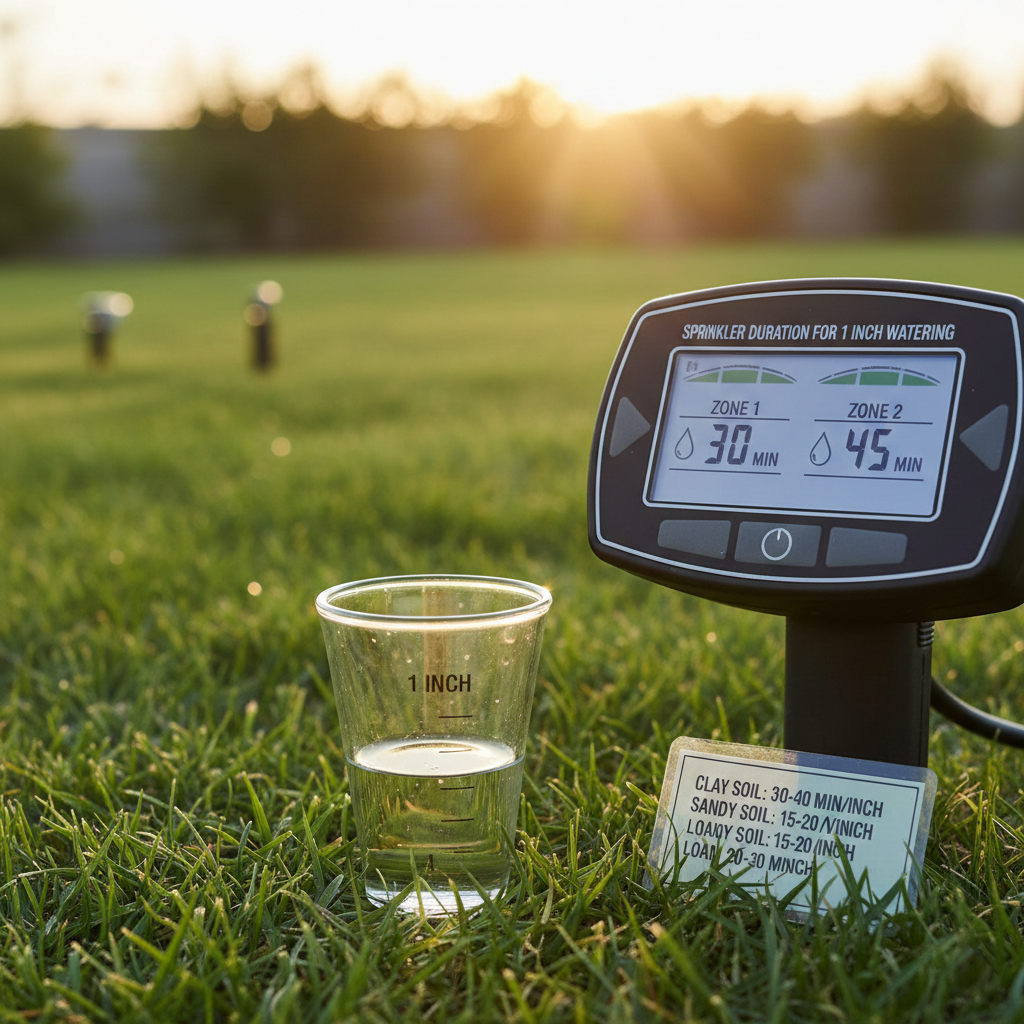
Smart sprinkler controllers can cut water waste by 20 to 50%. They check weather data and adjust your watering automatically.
I installed a Rachio 3 controller in 2023. My first month showed 34% less water use. No more watering right after it rains.
Popular Smart Controllers (January 2026)
| Controller | Price | Best Feature |
| Rachio 3 | $180-230 | Best weather data |
| Rain Bird WiFi | $100-150 | Budget friendly |
| Orbit B-hyve | $80-130 | Great value |
The Rachio has the best app. The Orbit costs less and still works great.
Common Watering Mistakes to Avoid
Most lawn problems come from simple watering mistakes. Here are the big ones:
Mistake #1: Watering at Night
Night watering seems smart because less water evaporates. But grass that stays wet overnight gets fungal diseases. I lost a big section of lawn to brown patch disease after switching to night watering.
Water between 4 AM and 9 AM.
Mistake #2: Light, Daily Watering
Watering 10 minutes every day feels productive. But it creates shallow roots. When hot weather hits, these lawns die fast.
Water deeply (1 inch) just 2 to 3 times per week.
Mistake #3: Ignoring Sprinkler Problems
Clogged nozzles and cracked parts waste water and create dry spots.
Check your sprinkler heads monthly during watering season.
Mistake #4: Watering After Rain
Running your sprinkler after a rainstorm wastes water and drowns your grass.
Install a rain sensor ($15-30) or use a smart controller.
Mistake #5: Overwatering New Lawns
New grass needs steady moisture, not constant flooding. Too much water causes disease and stops roots from growing deep.
Keep soil moist, not soaked. For new seed, water lightly 2 to 3 times daily for short periods.
How Much Does Lawn Watering Cost?
Most homeowners spend $30 to $60 per month on lawn watering. Bad habits can triple that number.
Here’s the math for a 5,000 square foot lawn getting 1 inch weekly:
– 1 inch on 5,000 sq ft = about 3,115 gallons
– Average water cost: $3.50 to $5.00 per 1,000 gallons
– Weekly cost: $11 to $16
– Monthly cost: $47 to $67
– Summer total (May-September): $235 to $335
After I fixed my watering habits, my water use dropped from 6,500 gallons per week to 3,400 gallons. Same coverage, half the water.
Adjusting for Your Climate
Different parts of the country need different watering schedules.
Hot, Dry Areas (Arizona, Nevada)
Lawns may need 2+ inches weekly in summer. Many cities don’t allow daytime watering.
Humid Southeast (Florida, Georgia)
The air holds more moisture, so you lose less to evaporation. But afternoon thunderstorms make scheduling tricky.
Pacific Northwest (Washington, Oregon)
Lawns often survive on rain alone from October through May. But dry summers still need irrigation.
Windy Plains (Kansas, Oklahoma)
Wind blows sprinkler water away. Water early morning when wind is calmest.
FAQs
How do I know if I’m watering enough?
Push a screwdriver into your lawn the day after watering. If it slides in 6 inches easily, you’re good. If it stops at 2 to 3 inches, you need more water.
Can you water too much?
Yes. Signs of overwatering include spongy soil, mushrooms, yellow grass, and more bugs and diseases.
What’s the best time to water?
Early morning between 4 AM and 9 AM. Less evaporation, and grass dries before night.
How often should I water in summer?
Most lawns do best with 2 to 3 deep watering sessions per week. Avoid daily light watering.
Does new grass seed need 1 inch too?
No. New seed needs light, frequent watering. Water 2 to 3 times daily for 5 to 10 minutes until grass sprouts.
Should I water if rain is coming?
Skip watering if you expect at least half an inch of rain within 24 hours.
How long should I water new sod?
Water new sod daily for the first week, about 20 to 30 minutes per zone. Then cut back to every other day.
What’s the best sprinkler for big yards?
Impact sprinklers throw water 45+ feet. For very big yards, in-ground systems work best.
Take Action This Weekend
Finding the right sprinkler time isn’t hard. You just need to measure instead of guess. Do the tuna can test this weekend. It takes 15 minutes and tells you exactly what your yard needs.
The biggest change most people can make? Stop watering daily and start watering deeply. Water 1 inch, 2 to 3 times per week. This one change makes lawns healthier than anything else.
What problems have you had with lawn watering? Have you dealt with brown patches or high water bills? Share your experience in the comments.
Want to explore more? Head over to Magzines